





Research Groups
At the Center for Hybrid Quantum-Classical Information Technologies (QLAB), we believe that the greatest innovations emerge at the intersection of various disciplines. That is why we conduct our scientific research in a fully comprehensive and complementary manner. The Center’s structure is based on four specialized research groups. These teams do not operate in isolation—they collaborate closely, continuously sharing acquired knowledge, experience, and access to our unique laboratory infrastructure.
With the strong support of leading national and international partners—including prestigious academic institutions and technology sector leaders—we successfully integrate quantum physics phenomena with classical information and communication technology (ICT) systems. Our overarching goal remains the effective transfer of knowledge directly to the economy. For this reason, all work carried out within the research groups is highly oriented towards creating tangible market value: patents, industrial demonstrators, and solutions ready for rapid deployment in strategic sectors such as telecommunications, precision medicine, cybersecurity, and modern space technologies.
We design advanced quantum communication and cryptography systems. We create secure wide-area networks and protect critical infrastructure against cyber threats.

Quantum Communication Infrastructure
We develop highly efficient photonic components and integrate them with quantum systems. We create modern light sources and test protocols under industrial conditions.

Quantum Imaging and Metrology
We build multimode photonic platforms that surpass classical detection limits. We develop innovative, ultra-sensitive microscopy systems for medical applications.
Quantum Computing and Artificial Intelligence
We investigate hybrid quantum algorithms and innovative neuromorphic models. We create energy-efficient software and photonic processors for next-generation systems.
Quantum-Safe Communication
Group Leader: Prof. Magdalena Stobińska-Moretto, Ph.D., D.Sc.
Partners: PSNC, ETH Zürich, Sorbonne University, Orange Polska
About the research area: The team is responsible for designing and developing advanced quantum communication systems. The work focuses on elaborating mathematical security proofs and exploring the applicability limits of the Entropy Accumulation Theorem (EAT). An important task of the group is to design unique, hybrid solutions that seamlessly merge quantum and post-quantum cryptography, laying the foundations for the global quantum internet.
Key results: The creation of secure, cyber-resilient network solutions designed for wide-area networks and the protection of critical infrastructure.
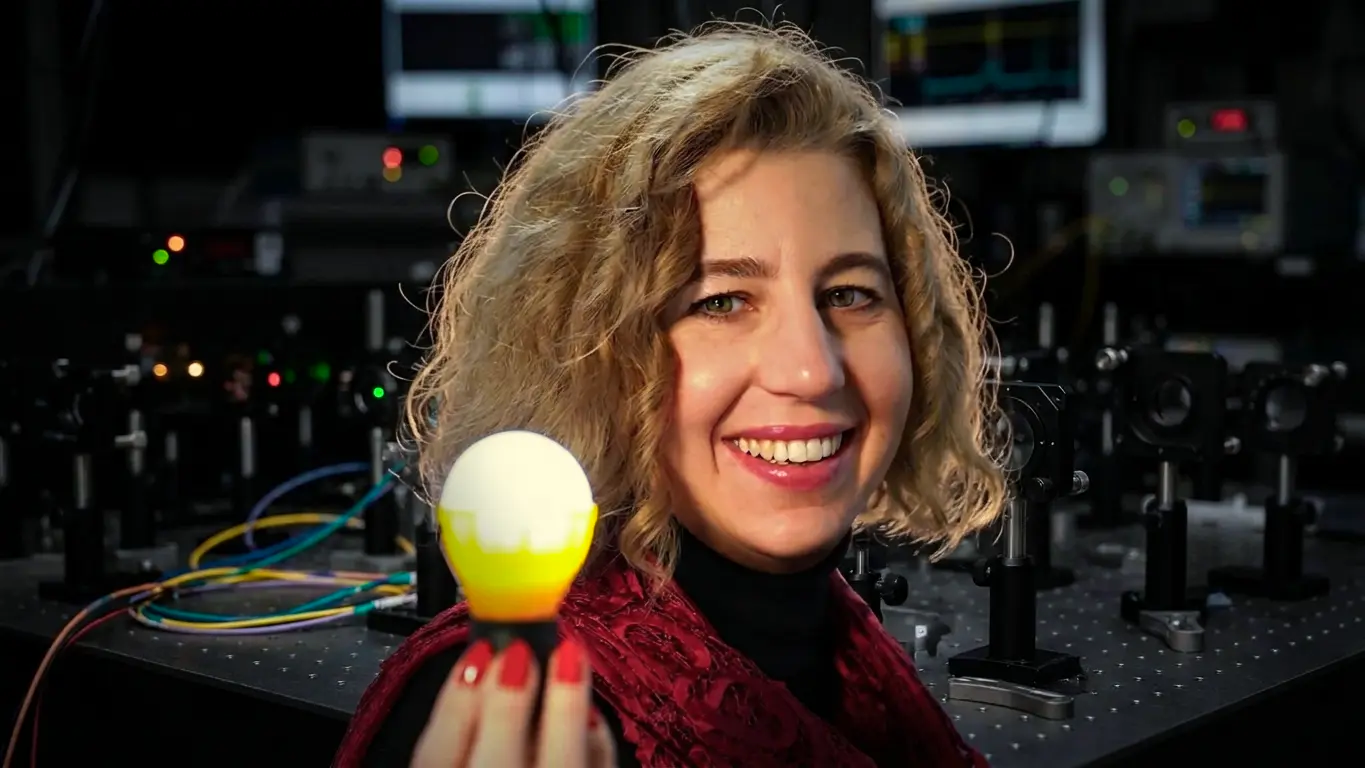
Quantum Communication Infrastructure and Photonic Information Processing
Group Leader: Michał Karpiński, Ph.D., D.Sc.
Partners: PSNC, Sorbonne University, Orange Polska
About the research area: The primary goal of the group is the development of modern photonic components and their seamless integration with quantum systems and existing ICT infrastructure. Researchers are working on novel, highly efficient quantum light sources, advanced detection technologies, and programmable photonic circuits. The team also creates specialized interfaces that ensure full interoperability and collaboration between classical and quantum systems.
Key results: The development of methods that enable the testing, validation, and full optimization of hybrid protocols in real-world industrial conditions.
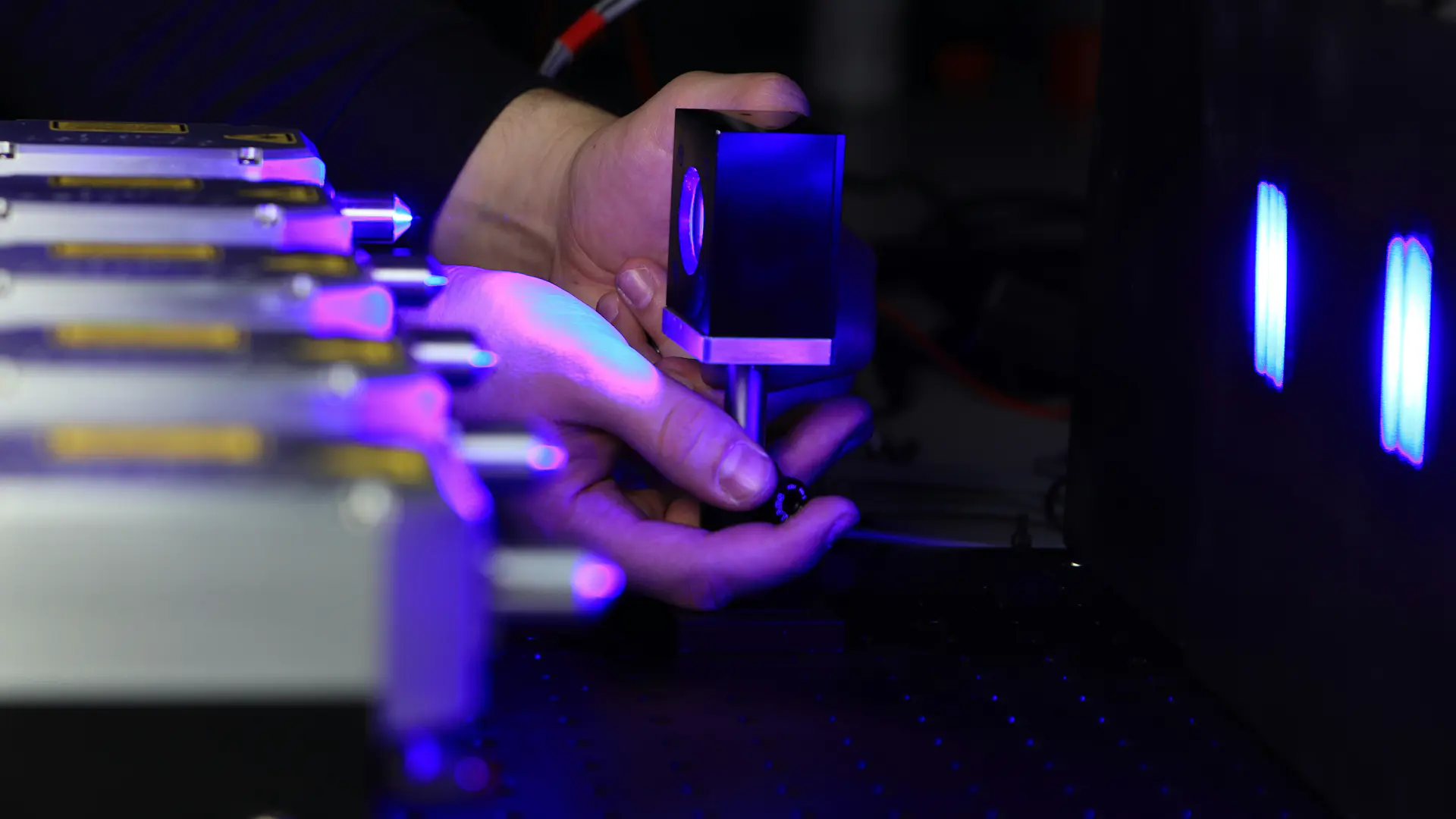
Quantum Imaging and Metrology
Group Leader: Radosław Łapkiewicz, Ph.D., D.Sc.
Partners: Sorbonne University
About the research area: The team focuses on advancing multimode photonic platforms that make it possible to surpass current classical physical limits in measurement and detection. Research encompasses the design of pioneering quantum imaging techniques, such as photon-correlation-based super-resolution microscopy, quantum optical tomography, and methods for mitigating light scattering. A significant aspect of the work involves detector array engineering and the direct integration of quantum effects into optical systems.
Key results: The construction of a new generation of ultra-sensitive microscopy and measurement systems, tailored for medical applications and advanced industrial sectors.
Quantum Computing and Artificial Intelligence
Group Leader: Michał Karpiński, Ph.D., D.Sc.
Partners: PSNC, Sorbonne University, Orange Polska
About the research area: The primary goal of the group is the development of modern photonic components and their seamless integration with quantum systems and existing ICT infrastructure. Researchers are working on novel, highly efficient quantum light sources, advanced detection technologies, and programmable photonic circuits. The team also creates specialized interfaces that ensure full interoperability and collaboration between classical and quantum systems.
Key results: The development of methods that enable the testing, validation, and full optimization of hybrid protocols in real-world industrial conditions.