
The development of quantum computers in the NISQ (Noisy Intermediate-Scale Quantum) era faces a fundamental barrier: decoherence and high noise levels that limit the depth of realizable circuits. Traditional error correction methods require thousands of physical qubits for a single logical qubit, which exceeds current hardware capabilities. The answer to this problem lies in synergy with artificial intelligence.
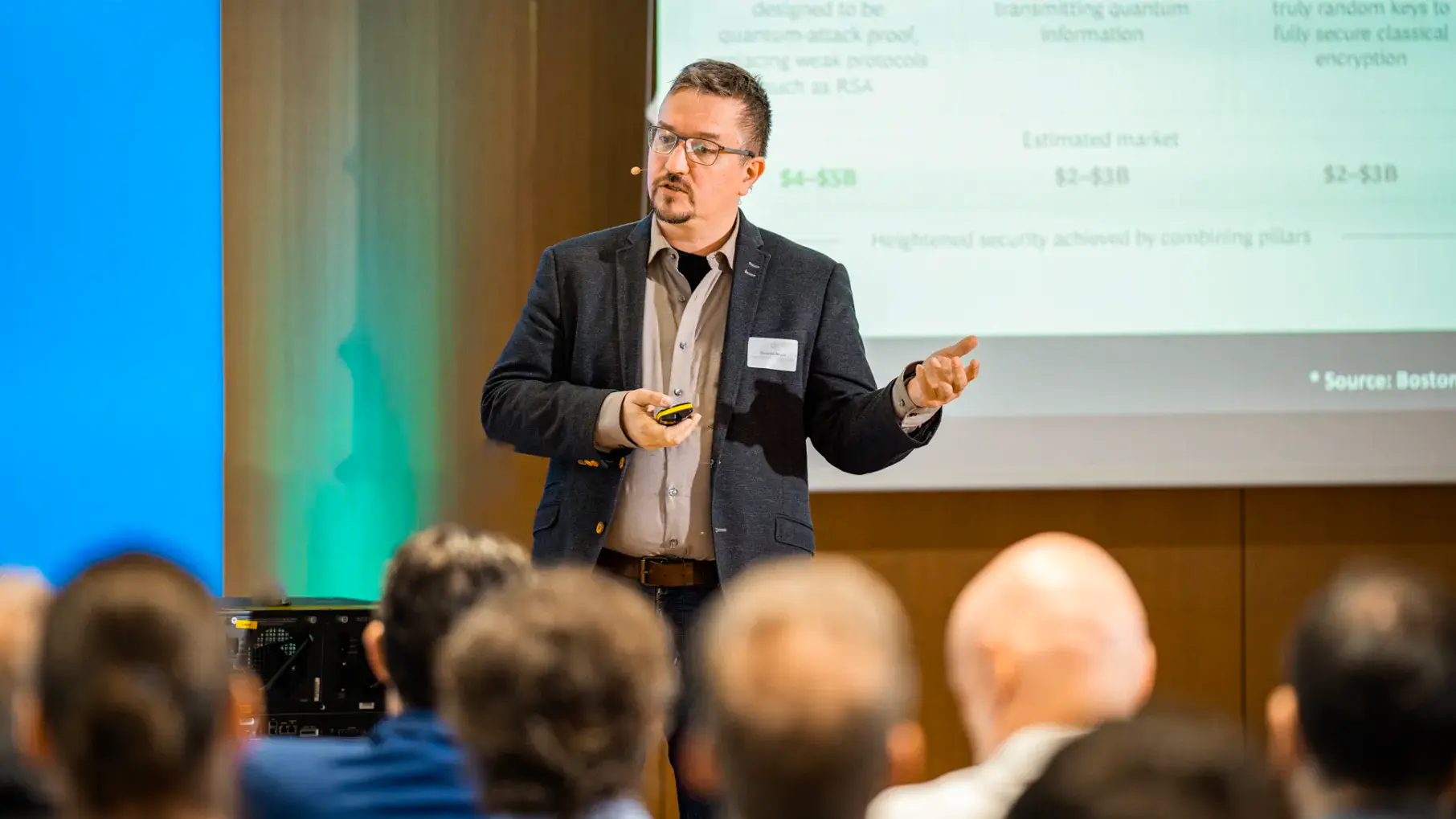
During this seminar, Prof. Thomas Monz from the University of Innsbruck will present a groundbreaking approach that utilizes classical machine learning models for error mitigation directly at the hardware level. We will focus on practical experiments conducted on ion-trap processors, demonstrating how neural networks can model, predict, and compensate for system noise.
Seminar Agenda:
- 10:00 – 10:15: Introduction: Limitations of NISQ architecture and the scalability problem.
- 10:15 – 11:00: Machine learning algorithms in quantum noise characterization.
- 11:00 – 11:30: Case study: Integrating HPC environments with an ion-trap processor.
- 11:30 – 12:00: Q&A Session.
Target Audience: This event is dedicated to quantum software engineers, AI researchers, HPC system architects, and STEM students who wish to delve into the topic of hybrid quantum-classical algorithms.